
Philosophy
A Little About My Golf Journey
The very first time I touched a club, I was 17 years old. That is a very late age to learn golf as a typical professional, and for touring pros, it’s almost unheard of. I had already played and been competent at other sports, but learning golf was an entirely different experience. Looking back, I think I loved golf right away, but to be honest, my love was baseball. An injury and other hurdles at that time in my life contributed to the switch. Little did I know that fork in the road would be such an integral part of my life and my family’s.
I put a ton of time into the first 5 years of golf. I soaked up every bit of information I could: books, magazines, videos, tips from people, tons and tons of practice, playing, etc. With very little to no meaningful improvement. It wasn’t until my mid 20’s, that I met Dave Stevenson and Mark Evershed. That is when my world flipped, and I went from a 12 handicap to a scratch golfer and earned my PGA professional card. Things finally began to make sense, and the game began to come to me. That journey has paid off in my teaching, and it wasn’t a straight or easy road. I’m not afraid to say it didn’t come naturally.
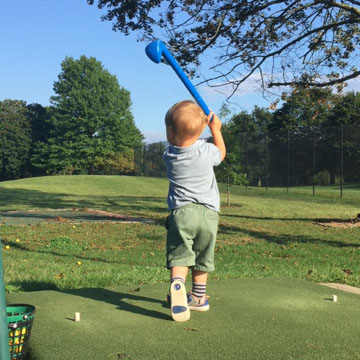
Always follow through, son. I Love You!
In my 25+ years of teaching, I’ve come to believe people move how they move for a reason. I don’t teach by watching someone swing and telling them what they are doing wrong. We figure out together how they see things and what makes sense to them, therefore learning why they move the way they do. For example, in the winter, when we use a net to hit into people, they typically change movements more easily because I believe they are not trying to hit high, straight, or far. They are just doing what we want them to.
Kids pick up the game quickly. They mimic well, so we demonstrate. We do drills to set foundational movements and build more and more. Think about how kids learn Karate: they work on skills, test on those skills, and advance to work on higher-level skills. We give them some space to feel things out. We will play games and I like for them to learn on the course as well. That may mean that they can’t explain easily to you what they learned. Another way of looking at it is that we try to give them little conceptual technical mechanical direction which is done in the prefrontal cortex where the logical thinking occurs in the brain. We try to stay in the cerebellum where the coordination happens.
- Think summer camp, with golf being the activity. After a full immersive week one of our goals is that they can go play on their own.
- I get a lot of questions about learning things like swing mechanics. It’s been a difficult thing for me to describe succinctly. It’s easier for people to experience it and understand afterwards. But here is my best shot. We promote as few foundational movements as possible without them thinking. An example is we will play games. For example, we can play Simon Says and/or a freeze game with some different positions, sometimes without hitting. If their weight ends resting on their front foot and their hands work well, we give plenty of space around those 2 foundational movements. We will teach them what clubs to use where, different shots, how to care for the course and respect others, etc.
- If you prefer mechanics and really working hard on your game, consider private, semi-private lessons, or other groups run by Kevin.
- We want golf to be apart of their lives and make friends around the game. This is a good opportunity to get on the course and practice.
- Parents ask how kids get interested. From my experience they really get drawn into golf if they make friends around it. Spring and fall are easy going way for them to hit some balls on the range, play a hole or two and have some friendly games. Tic Tac Putt anyone? So keep golf in the forefront of their minds and make friends. We even had a couple of our juniors who met here tie the knot (click to see their story!
- If you want instruction, I suggest private or semi-private lessons or group lessons led by Kevin.
Very much like our spring and fall programs, but Kevin personally runs the groups. So these programs tend to be more instructive in feel. The group has a smaller limit of 8. We utilize the indoor studio. We set up 4 stations/games/drills/challenges. Think small group high intensity interval training.
- Typically Kevin runs these programs, sometimes with senior staff help. We set goals at the begging of class. There is a range, but everyone wants to get better at golf. Not just hitting but all aspect of the game. To fully get the experience we hope you want. You must carve out minimum 15 minutes to practice in-between lessons. We will give you tools to practice and resources to use on your own. One of our goals is that you leave being able to navigate the overwhelming amount of golf tips our there… and things you learn make sense!
- Groups can be a little different depending on ability level, experience with me, length of time, size of group, etc. But typically we stick to the same general outline of;
- First day- use of videos, pictures, demonstrations, drills, and homework (yes, homework). Typically very minimal hitting. Learn what happens to the club, ball, and our body during a good golf shot. Why is it easier for us to do it that way, why can it be so mentally challenging, and how the heck do we do it consistently? Understanding ball flight laws, cause and effect. Understand the pitfalls of overthinking and over-analyzing.
- Day two- see how the info from day 1 translates to hitting for the student. We do lots of hitting. Drills include, but aren’t limited to: the reverse drill, 6 steps, and/or the V drill.
- Day three- short game
- Day four- learn the different clubs and putting.
- Day five- Teachers choice, including tips for getting on the course.
From my experience golfers progress quicker indoors. They aren’t distracted by trying to hit it up, straight, far etc. If you are focused on the result it can be difficult to work on things. People typically are more open to doing drills and are more patient indoors. We have an Apogee golf simulator, 2 nets and a putting area. We set up different stations with different drills, games, skills. Think interval training.
- First we discuss your goals, and I’ll ask you questions that will dictate how the lesson goes
- I’ve got two distinct and different approaches. The first I call my outing approach. This is when someone needs to get ready for an outing or event. Typically, these lessons are shorter on explanations, and you may hear some cliché bits of advice to get you to be able to get by.
- The other is a longer-term approach: I’ll find out where you’re lacking in knowledge, and I’ll work to fill in the blanks so things make more sense for you. (Beginners- on your first lesson, you may not hit. Also expect homework with drills and videos that must be done before the 2nd lesson, where we will do our first hitting.)
- Sometimes I may play you a video clip. I’ve spent thousands and thousands of hours looking at video clips to whittle them down to only a couple I truly like. I would not suggest looking through the thousands and thousands of video clips online. It may not be a good idea 🙂
- I was in your shoes! It’s a difficult game.
- Don’t feel intimidated. Everyone starts somewhere, and most people on the golf course are far more focused on their own game than on judging someone else’s.
- Build comfort, safety, confidence, and basic understanding. We want you leaving understanding what you learned and what you need to practice.
- Overthinking and perfectionism can work against you early on. The goal is not to build a perfect swing overnight. The goal is to learn the game in a way that feels approachable, safe, and enjoyable.
- People’s instinct is to get underneath the ball to help the ball up. But that’s not correct for golf, it’s counterintuitive. For example, you hit down to make the ball go up and swing left to make the ball go right.
- Knowing is half the battle – Many times I have taught a lesson and after just a good description of what is meant to happen and why people end up moving differently. Did I mention how important it is to get comfortable with the concept of hitting down?
- Get on the course to watch other people golfing. This puts the game into context and gives you an idea of what people are doing and when. It also gives you the scale of the game. Watching golf on TV isn’t very practical for beginning golf and can be intimidating to someone wanting to pick up the game.
- Learning what golfers care about is important. Golfers care about safety. They don’t want to be paired up with someone who doesn’t know where to go or when to swing. They also don’t like waiting as the pace of play takes some understanding.
- Understanding how the ball goes in the air is vital to understanding why the ball goes where it does. Keep swing thoughts simple, and understandable. You need to know why the ball goes where it does
Usually need a more specific plan. The work may include;
- Make your weaknesses your strengths.
- Short game
- Course management
- Understanding impact (cause and effect)
- Set goals, compose a training schedule, and ideally a competitive schedule
- For serious players, improvement is not just about knowing what is wrong. It is about knowing what to practice, how to measure progress, and how to bring better decision-making and execution to the course.
- Please see my bio and influences. I like to know the why. I relate my experiences as a student to my teaching.
One concept Kevin often uses is teaching from the finish backward. When the body understands where it is trying to go, it often becomes easier to organize the movement needed to get there.
This approach helps students develop better awareness, balance, rhythm, and coordination. It also keeps the lesson focused on a clear result instead of disconnected pieces of the swing.
You do not need to be naturally athletic to improve. You need clear instruction, realistic goals, and a practice plan you can actually follow.
Many golfers can hit good shots on the range but struggle to bring those same skills to the course. That gap matters.
Kevin Chin Golf helps students learn how to practice productively. That may include drills, skill challenges, target-based practice, short game work, simulated course situations, pre-shot routines, and on-course coaching.
The goal is to make practice more useful, not just longer. Better practice should help golfers build confidence, make better decisions, and play with more consistency.
First off I am amazed at the improvement of my golf instruction feeds from social media. It can be a wonderful resource! But it can be overwhelming and not all the stuff out there would I suggest. If you asked me 2 years ago if a beginner should try to learn online. I’d say no way. But now I feel like part of the value of lessons with me is that you will leave me with the tools to navigate the internet, and pay attention to the stuff that will help you.
Here is an example of how using google messed up a student of mine; They looked at google to see where their weight distribution should be at set up. Google said 50/50, for woods you should have more weight on your back foot and with irons you should have more weight on you front foot. What!?! If you should have your weight on your back foot for woods and front foot for irons when would you ever be 50/50? Yuck! Hopefully you will leave every lesson with absolutely no contradictions ever! And everything must make sense!
I asked Google the other day what was the most detrimental golf tip. Google said that the most detrimental tip is to keep your head down! That’s a long way from what I thought was common knowledge. Everyone knows to keep your head down. If that isn’t conflicting information, I don’t know what is.
Kevin’s list of most detrimental golf tips; (these tips may actually have some good value but too often are misunderstood and some are just downright bad and or wrong.
- Keep your head down, Keep your eye on the ball.
- Why the tip can be detrimental. many people try to keep there head still.
- Kills Rotation: Forcing your head to stay frozen stops your shoulders and chest from turning fully through the shot.
- Destroys Posture: Trying to stay low causes your upper body to dip or stall, leading to heavy “fat” hits or thin “bladed” strikes.
- Blocks the Follow-Through: A natural swing requires your body to unwind and your head to rotate up and toward the target after impact.
- Watch where the ball goes. LOL.
- keep your lead arm straight
- Why the tip can be detrimental. STIFF, hindering turn, and it’s a pain to change this habit from my experience personally and teaching.
- swing out to the target
- inefficient.
- power comes from your lower body
- why the tip can be detrimental; 77% of your power comes from elbows to fingertips.
- Shift your weight
- This is true and important but it’s important to understand.
- Keep your club square
- Toe rolls. club is square to you but not to the target. the ball squishes and rides the club face.
- Hit down
- Wait what?! This may be one of the single most important things to know to really achieving good ball striking. It’s the first thing I discuss with any beginner or intermediate adult. So why is it on this list? Because I find when people try to do this they do worse. And I very much include myself on this list. So we do drills to promote shaft lean and hitting down without your trying to accomplish it. It is too darn difficult to jump right to.
- Keep you weight 50/50 at set up. Ugh, I think this is just down right wrong and terrible for people.
- Google said “a standard full swing generally starts near 50/50, but then says irons should put weight on front foot and woods on back foot. So my question is when is there anything else? So it’s never 50/50? It makes no sense!
I really geek out on how people learn, and how the brain works. The parts of the brain in particular that I focus on is the cerebellum and the cerebrum. I’ve been very lucky to teach golf to some very helpful and generous neuroscientists who we have had many a discussion. We also have a consultant on staff Nigel Pereira.
Key functions of the Cerebellum;
Main Motor Functions
- Muscle coordination: Times and adjusts muscle groups so your body moves smoothly.
- Balance and posture: Keeps you steady and upright by responding to shifts in your position.
- Fine motor skills: Controls exact, small movements like writing, typing, or playing an instrument.
- Eye movements: Helps your eyes track and fixate on moving targets.
Learning and Non-Motor Functions
- Motor learning: Stores “muscle memory” so actions like riding a bike or hitting a ball become automatic through practice.
- Cognitive processing: Contributes to attention, language, and problem-solving.
- Emotional regulation: Plays a small role in managing mood and behavior.
Key Functions of the Cerebrum
- Reasoning and Logic: Handles complex problem-solving, planning, and decision-making.
- Sensory Processing: Interprets information from your five senses (sight, sound, touch, taste, and smell).
- Language: Controls your ability to speak, read, and write.
- Memory: Stores both short-term (working memory) and long-term memories.
- Voluntary Movement: Directs conscious and planned muscle movements.
We don’t want these two parts of the brain fighting! And in golf I believe if you learn as an adult initially they can, that is why it is so important for them to agree with one another!
One of my all favorite stories is that of Hugo Sosa. Feel free to google him. He has an amazing story to tell. But I’m going to keep it to golf for now. He joined one of our adult groups.
When I first work with a beginner, whether it’s a private lesson or in a group setting I have a typical spiel. We talk about theory of how the ball goes in the air. Then we do some movement exercises, then we proceed to hit. When the students begin to hit I tell them to focus on the movement that we just practiced and not what the ball is doing, because the ball can give you terrible feedback early on and your brain can be so concerned about what you’re doing wrong it can distract you from the drill we are doing.
When we started to hit as a group, I told them to focus on how they looked at the end of their swing. Hugo took this to heart more than any other I’ve ever worked with and he really had fun with it. He did what I said which was don’t worry about what the ball does but worry about how you look at the end of your swing. He said and I quote “you want me to look good at the end of my swing? He said I could do that. No problem!” And he proceeded to pretend that every swing was the best shot of his life and he was at the U.S. Open. And another funny thing was happening is that he was hitting the golf ball really bad and it wasn’t even a consideration because I told him not to worry about what the ball does. He wasn’t getting deterred so I let him continue hitting and came back to him in about five minutes and because he had been practicing that movement, well it was easy for me to add a little adjustment to him and I said I want you to do this a little bit different it’s pretty much the same thing with this tiny little change he said OK that’s not that big a deal give me a couple minutes to get used to that. And I came back a couple minutes later I said all right Hugo it’s time to start hitting golf balls again, and when he did, there was a huge leap and almost every shot was fantastic.
The moral of the story is that I don’t know a way to make you perform all the movements you need to do to hit the ball well. What we do instead is discuss why 1 or 2 movements are beneficial and practice those things. Once they feel easier, repeatable and taking less conscious effort then we can add another thing, but make sure not to sacrifice the thing we were working on.
When you are getting used to a movement, especially a new one. You need time to get used to the movement before trying to control where the club is. Give it time to get used to is. Your intuition will typically tell you if it feels good and that can be a better indicator to how you’re progressing.
I don’t think I will ever ask a student to perform a movement that if physically difficult to do. It may be mentally challenging but not physically. One of my students said she couldn’t do what I asked of her. I said can you do it for a million dollars. And sure enough she said sure no problem. And in this case she proceeded to hit the best shot of her life. I don’t expect that at all, but her lesson was that if you open yourself up to doing something different and maybe uncomfortable you open yourself up to CHANGE! It’s part of my job to convince you that what we ask of you is important. Problem is I don’t have millions of dollars to hand out to all my students.
